Can Robotic Lawn Mowers Handle Uneven Terrain & Slopes? (Australian Yards Guide)

If you've been wondering whether a robot lawn mower can actually cope with your bumpy, sloped, or awkwardly shaped backyard, you're not alone. It's one of the most common questions Australian homeowners ask before making the switch to automated mowing, and for good reason. Australia's suburban landscapes are anything but flat.
The short answer is: yes, modern robotic mowers absolutely can handle uneven terrain and slopes. But not all models are created equal. In this guide, we break down exactly what to look for, how slope ratings work, and why ADVINSYS is purpose-built for the kinds of complex, real-world yards found across Australian suburbs.
Why Australian Yards Are Particularly Challenging
Australia's varied topography makes lawn care uniquely demanding. From the hilly suburbs of Brisbane and Perth to the sloped coastal blocks of Sydney's Northern Beaches, a significant proportion of Australian residential properties sit on terrain that's anything but level. As landscaping specialists at Cut n Chipped Australia note, sloping gardens are not just common across the country, but they're the norm in many regions, presenting real challenges around drainage, erosion, and maintenance access.
Common terrain challenges in Australian yards include:
-
Moderate slopes (15–30%): typical of suburban blocks with natural drainage shaping or terraced gardens, found in suburbs across Melbourne, Sydney, and Brisbane
-
Complex multi-zone layouts: lawns divided by garden beds, paths, trees, and outdoor structures that require precise navigation
-
Damp, slippery surfaces: particularly in winter, when wet grass and soft soil reduce traction significantly
-
Narrow passages: between fences, garden beds, and structures that standard mowers struggle to navigate cleanly
-
Uneven ground: tree roots, ruts, and natural undulation that can disrupt cutting consistency
For manual mowing, these challenges mean physical effort, safety risk, and inconsistent results. For the wrong robotic mower, they mean getting stuck, missing patches, or damaging your turf.
Understanding Slope Ratings: What the Numbers Actually Mean
Before shopping for a robot mower for a sloped yard, it helps to understand how slope ratings are measured and what they mean in practice.
Slopes are expressed in two ways: degrees and percentages. A percentage slope represents how much vertical rise occurs per unit of horizontal distance. For example, a 33% slope means the ground rises 1 metre for every 3 metres of horizontal travel.
Here's a practical reference guide:

As the team at Lawn Robots Australia points out, entry-level robot mowers typically handle slopes up to around 20–25%, while premium models with four-wheel drive or advanced chassis engineering can manage significantly steeper terrain. The key is matching the mower's rated capability to your actual yard gradient before purchasing.
How to measure your slope: You'll need two stakes, a length of string, a tape measure, and a spirit level. Drive one stake into the ground at the top of the slope and one at the bottom. Run the string horizontally (use the spirit level to confirm it's level) from the top stake to a point directly above the bottom stake. Measure the vertical drop from the string to the ground and the horizontal distance between stakes. Divide the vertical measurement by the horizontal measurement and multiply by 100 to get your slope percentage.
Where Robot Mowers Actually Fail on Slopes
Most robotic mowers work well enough on flat ground. The real differences between models only become obvious once terrain gets complicated, and in Australian backyards, complicated terrain is the norm rather than the exception.
Three problems come up repeatedly on sloped or uneven lawns, and understanding them makes it much easier to know what to look for when comparing mowers.
The first is traction loss. Wet grass, loose soil, and inclines all reduce wheel grip. When a mower loses traction mid-slope, it doesn't just pause. It can slip sideways, leave uncut strips, or dig wheel ruts into soft turf. As terrain specialists note, slippage also forces the mower to re-cut the same area repeatedly, which adds unnecessary wear to both the machine and the grass. The practical takeaway: check that a mower's slope rating has been tested on wet grass, not just dry, and look for deep-tread tyres designed to maintain grip in damp conditions.
The second is navigation reliability. Traditional boundary-wire systems can shift position after heavy rain or soil movement on sloped ground, creating boundary errors that interrupt mowing or send the mower into areas it shouldn't enter. Robolever's buying guide for sloped lawns points out that even turning on a slope presents a challenge for wire-guided mowers. Most require a flat exit zone to turn safely, which limits how much of a sloped yard they can actually cover. Wire-free navigation sidesteps these issues entirely, since virtual boundaries don't move when the ground does.
The third is obstacle detection accuracy. Standard sensors are calibrated for flat ground. When a mower is tilted on a slope, the same sensor that reliably spots a garden stake on level terrain may misjudge its distance or miss it entirely. This is particularly relevant in Australian yards where sloped sections often include tree roots, raised garden edging, or outdoor furniture — obstacles that shift in apparent position depending on the mower's angle. Genuine 3D perception, which accounts for the mower's own pitch and roll, handles this far more consistently than flat sensor arrays.
Beyond these three core challenges, two practical factors are worth checking for Australian conditions specifically. The first is all-weather durability. Australian winters bring extended periods of rain and damp ground across most of the country, so a mower that suspends operation every time conditions aren't perfect will leave your lawn undermaintained for weeks at a time. The second is physical size. Sloped Australian yards frequently include narrow side passages between fences and garden beds, and a mower that can't fit through these gaps simply won't cover the whole yard.
How ADVINSYS Handles Australian Terrain
Totally Wire-Free AI Navigation
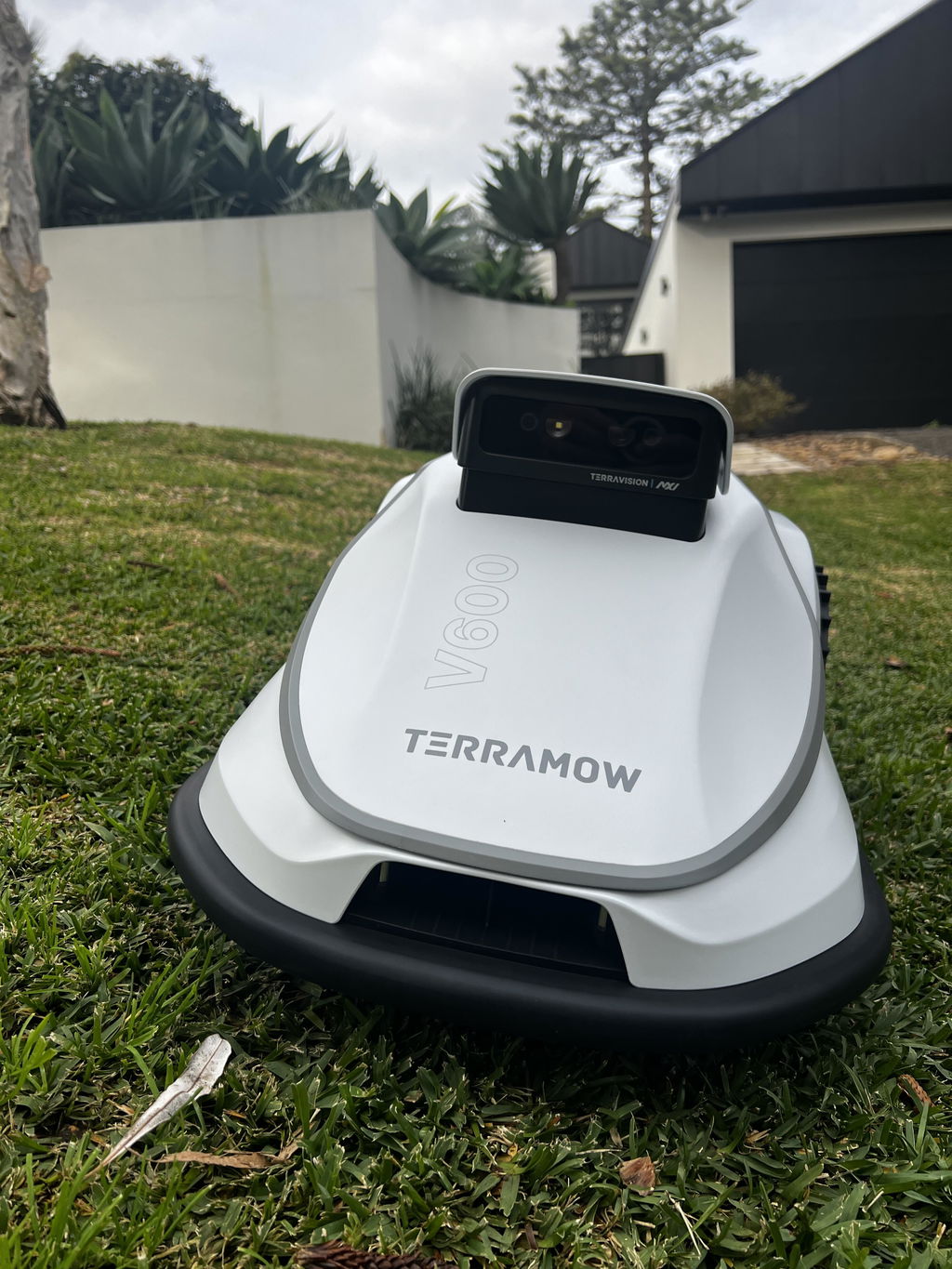
The navigation system is where the V Series makes its most significant departure from conventional robot mowers. ADVINSYS uses a triple-camera setup with 1920×1280 resolution imaging. No boundary wires, no RTK antenna installation, no dependence on GPS signal quality. The cameras feed into an AI system that builds and maintains a map of your lawn in real time, identifying landmarks, edges, and obstacles continuously as the mower moves.
Setup takes under five minutes. Power on the mower, pair it with the app, press one button, and it automatically maps your entire lawn, and detects edges, garden beds, obstacles, and boundaries without a single cable to bury. This wire-free approach is particularly valuable for sloped yards where soil movement can shift buried wires out of position over time.
32.5% (18°) Certified Slope Capability
Both the V600 and V1000 models are certified to handle slopes up to 32.5% (18°), comfortably covering the gradient range found in the vast majority of Australian suburban yards. This rating has been independently tested and consistently confirmed in third-party reviews, including a detailed assessment by Birdito which noted the V1000's confident navigation of gently to moderately sloped terrain without loss of cutting consistency.
On slopes, the mower maintains steady movement rather than the jerky corrections seen in basic models, producing even results across the full gradient.
IPX6-Rated Weather Protection
The entire V Series features IPX6-rated performance, meaning it operates safely through persistent rain, drizzle, and wet lawn conditions. For Australian winters, particularly in southern states where lawns remain damp for extended periods, this means no forced days off and no risk of water damage.
3D Obstacle Avoidance
TerraVision 2.0's 3D perception system detects and avoids over 99% of obstacle types in real time, including garden furniture, pets, children's toys, tree roots, and raised garden edges. Because the system uses genuine 3D vision rather than flat sensor arrays, it functions accurately regardless of the mower's angle on slopes, addressing one of the core failure points of standard obstacle detection systems.
Compact Profile for Complex Garden Layouts
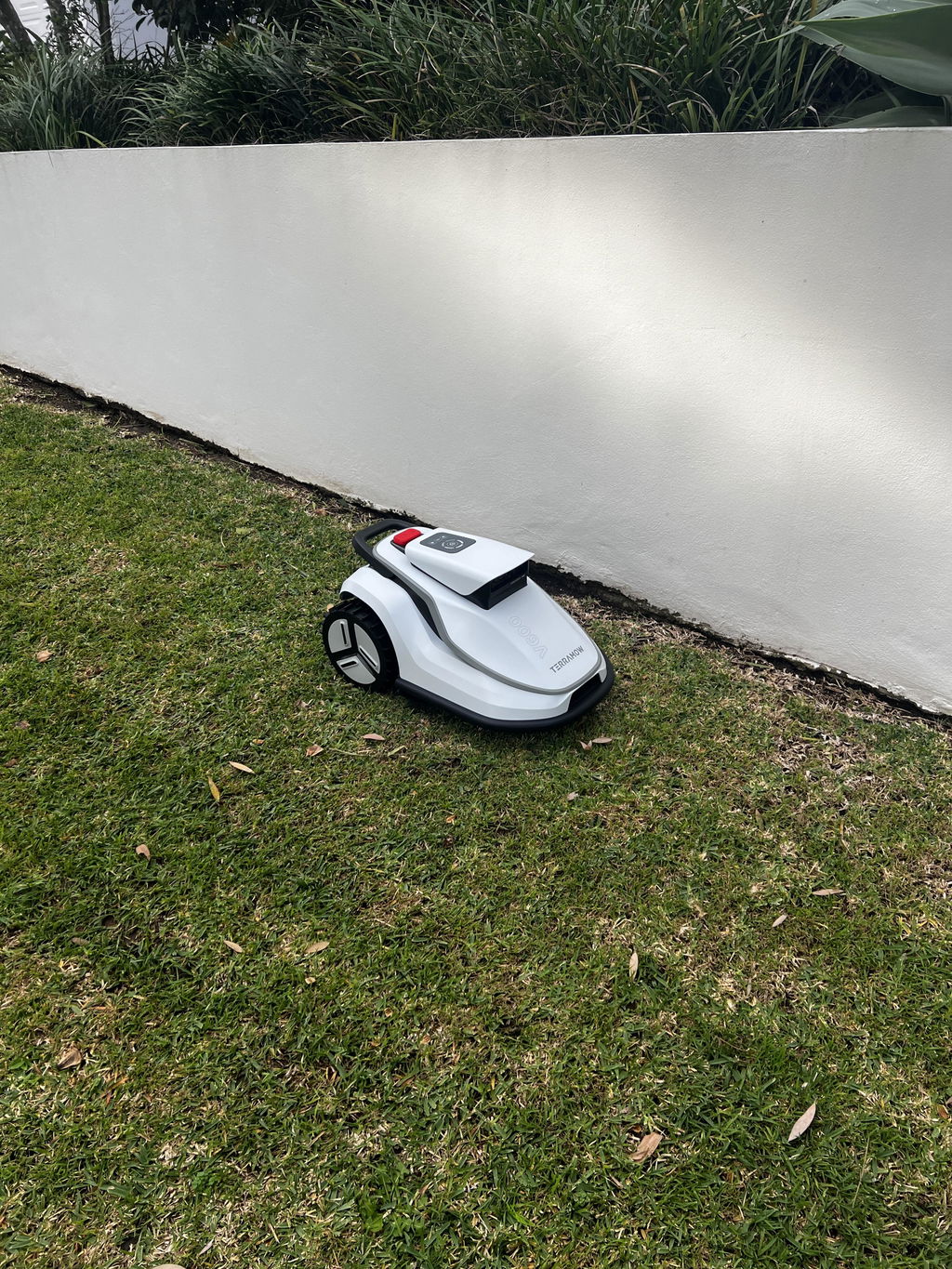
The V Series' compact chassis design allows it to navigate narrow passages and tight spaces that bulkier mowers cannot access. In Australian yards where garden beds, clotheslines, and side passages create narrow corridors, this matters practically. It's the difference between full coverage and patches the mower simply can't reach.
V600 vs V1000: Which Is Right for Your Yard?
For most Australian suburban blocks, typically 400–800m² of lawn area, the V600 is the practical starting point. For larger properties or yards where multiple zones and extended runtimes are needed, the V1000 is the stronger fit.
Both models are supported by OTA (over-the-air) software updates, meaning performance improvements and new features are delivered automatically without the need for service visits.
Practical Tips for Running a Robot Mower on Sloped Australian Terrain
Even with a capable mower, a few setup and maintenance habits will help you get the best results on uneven ground:
Position the base station on flat level ground. The charging station needs a stable surface, ideally at the bottom of any slope rather than mid-gradient, so the mower can dock and undock reliably without tipping.
Use zone mapping to manage complex layouts. The dedicated app allows you to define separate mowing zones, no-mow areas, and boundary adjustments directly on your phone. If your yard has distinct sections separated by paths or garden beds, setting these up as separate zones improves coverage accuracy.
Avoid scheduling during or immediately after heavy rain. While the V Series handles wet conditions well, mowing waterlogged soil on a slope can cause surface compaction and tracking. Schedule mowing when the lawn is lightly damp rather than fully saturated.
Maintain a slightly higher cutting height in winter. As Lawn Solutions Australia recommends for warm-season grasses like Couch and Buffalo, keeping cutting height above 30–40mm during cooler months protects root systems, and this is especially relevant on sloped sections where soil temperatures drop faster.
Keep blade checks regular. Mowing on uneven ground puts slightly more load on cutting blades. A quick visual check every four to six weeks ensures clean, consistent cuts and extends overall mower life.
Choose the Right Care for Your Lawn
The idea that robot mowers only work on flat, uniform lawns is well out of date. Modern AI vision mowers like ADVINSYS handle the kind of sloped, multi-zone, obstacle-rich yards that define Australian suburban living, without wires to install, signals to maintain, or constant manual adjustment.
If your yard has been putting you off robotic mowing, it's worth reassessing with the right specs in hand. Featuring a wire-free AI vision navigation system, a certified 32.5% slope-climbing capability, IPX6-rated water resistance, and exceptional 3D obstacle avoidance, ADVINSYS is truly your premier choice.