How Often Should You Mow Your Lawn in Australia? A Seasonal Schedule for Robotic Mower Owners

If you've recently invested in a robotic lawn mower, or you're thinking about making the switch, one of the first questions you'll ask is: how often should I set it to mow? Unlike traditional lawn mowers, robotic mowers work best when programmed to match the actual growth rate of your lawn throughout Australia's distinct seasons.
Australia's climate ranges from the tropical humidity of Queensland to the cool, wet winters of Victoria and Tasmania, and your lawn's mowing needs shift dramatically between December and July. This guide gives you a practical, season-by-season mowing schedule specifically designed for robotic mower owners, with advice tailored to common Australian grass varieties including Buffalo, Couch, Kikuyu, and Zoysia.
Why Mowing Frequency Matters in Australia
The golden rule of lawn care, whether you're using a robot mower or a traditional petrol mower, is the one-third rule: never remove more than one-third of the grass blade in a single mow. Cut more than that and you stress the plant, expose the crown to sunburn, and create that undesirable yellowed "scalped" look that's surprisingly common in Australian backyards over summer.
According to LAWN SOLUTIONS, maintaining correct mowing height and frequency is one of the single biggest factors in lawn health, which is more impactful than fertiliser or watering schedules for most home lawns. Mow too infrequently and you're taking off too much at once; mow too often and you can weaken root systems.
This is where robotic mowers have a genuine structural advantage: because they mow little and often, sometimes every day or every second day during peak growth. They naturally stay within the one-third rule without you having to think about it. The clippings they produce are so fine they act as a natural mulch, returning nitrogen to the soil. Lawn scientists call this grasscycling, and the Gardenate community has long championed it as a sustainable approach for Australian conditions.

A Season-by-Season Mowing Schedule for Australian Lawns
Australia's four seasons drive very different growth patterns depending on your grass type and where you live. Getting the timing right for each one is what separates a lawn that stays consistent year-round from one that's constantly playing catch-up. The Lawn Tips seasonal care guide is a useful local reference if you want more detail alongside what's covered here.
Summer (December – February): Every 1–3 Days
This is when warm-season grasses really go for it. Depending on your grass type and how much rain you've had, your lawn can put on visible growth within 24 to 48 hours during a hot, humid stretch. For most Australian lawns, running the robot mower every one to three days is appropriate, and for some grass types, daily is the right call. If your mower supports scheduling by percentage of weekly hours, set it to 70–100% during this period.
One adjustment worth making in summer: raise the blade height by about 10 to 15mm above your normal setting. Longer grass shades the soil, keeps moisture in, and protects the root zone from the worst of the heat. It might feel counterintuitive to let the lawn sit a bit longer, but it genuinely reduces stress on the plant through January and February.
Autumn (March – May): Every 3–5 Days
Growth starts slowing down as temperatures drop, though in Queensland and the NT the change is more gradual. For most of the country, you can start pulling back on mowing frequency through March. Every three to five days is usually fine, and by late May you're probably looking at twice a week at most. In app terms, scaling back to around 50–60% of your summer schedule is a reasonable starting point.
Autumn is also a good time to walk the cutting height back down incrementally. Don't drop it all at once; lower it a few millimetres every couple of weeks as the season progresses.
Winter (June – August): Weekly or Pause
For warm-season grasses, such as Buffalo, Couch, Kikuyu, Zoysia, winter means semi-dormancy. Growth slows right down or stops almost entirely. A lot of robot mower owners pause the mower completely during June and July, or drop back to a single weekly run just to keep things tidy. On most mower apps, 10–20% of summer hours is plenty, or you can pause entirely.
The exception is cool-season grasses in Victoria, Tasmania, and the ACT highlands. Tall Fescue and Ryegrass actually prefer cooler conditions and will keep growing actively through winter. If that's what you've got, twice-weekly mowing might still be on the cards even in the middle of June, which is around 40–50% of a normal schedule.
If your mower has a frost detection feature, this is the time to use it. Mowing frosted grass is a good way to damage it.
Spring (September – November): Every 2–4 Days
Spring is arguably the most important season to get right. As the soil warms up, warm-season grasses come out of dormancy and the growth rate accelerates quickly — sometimes surprisingly quickly. Start at around 40% of your maximum hours in September, ramp to 80% by October, and aim to be running daily or every other day by November.
The patterns you establish in spring set the tone for the whole summer. A lawn that goes into December dense and well-maintained is far easier to manage than one that's been allowed to grow patchy or uneven over spring. Don't wait until the growth surge is obvious before increasing frequency. By then you're already playing catch-up.
Grass Type Makes a Big Difference
The seasonal schedule above is a starting point, but your grass type significantly affects where you land within those ranges.

Kikuyu deserves a special mention. It's one of the most aggressive grasses in the country, and in a wet summer it can genuinely look untidy within two or three days of being mowed. For Kikuyu lawns, running the robot daily isn't excessive. It's often the only way to stay on top of it. Bunnings' Kikuyu care guide recommends weekly mowing as a baseline during peak growth, which for a robot mower translates to daily or every-other-day passes. The flip side is that Kikuyu goes properly dormant in winter, so you can switch the mower off entirely for a couple of months and it won't cause any problems.
Zoysia is the opposite. It grows slowly, handles drought well, and doesn't need much attention. If you've got Zoysia, you'll likely find yourself dialling back the mowing schedule more than you expected, which is actually one of the reasons people choose it.
Buffalo sits somewhere in the middle. It's popular across coastal NSW and Queensland for a reason: it handles shade, it's reasonably drought-tolerant, and it doesn't need constant attention. Every two to three days in summer is usually plenty.
How Robotic Mowers Change the Game
Most mowing advice assumes you're doing it once a week. Robot mowers throw that assumption out the window, and the results tend to be noticeably better for it.
Because robotic mowers operate on a schedule, cutting a small amount every day or every few days, they keep the lawn in a near-constant state of active growth stimulation without ever stressing the plant. This continuous, gentle cutting:
-
Denser turf over time. Frequent, light cutting stimulates lateral growth rather than vertical height. The result, after a season, is a noticeably thicker lawn that holds its density without extra intervention.
-
Natural weed suppression. A dense lawn leaves little bare soil for weed seeds to establish. No chemicals, no manual weeding. The grass does the work.
-
No clipping disposal. Micro-clippings decompose within days, returning up to 25–30% of the lawn's nitrogen needs back into the soil. In turn, this natural fertilization helps the grass grow stronger and requires less synthetic fertilizer throughout the year.
-
Significantly less of your time. The robot handles the schedule entirely. You set it once per season and leave it alone.
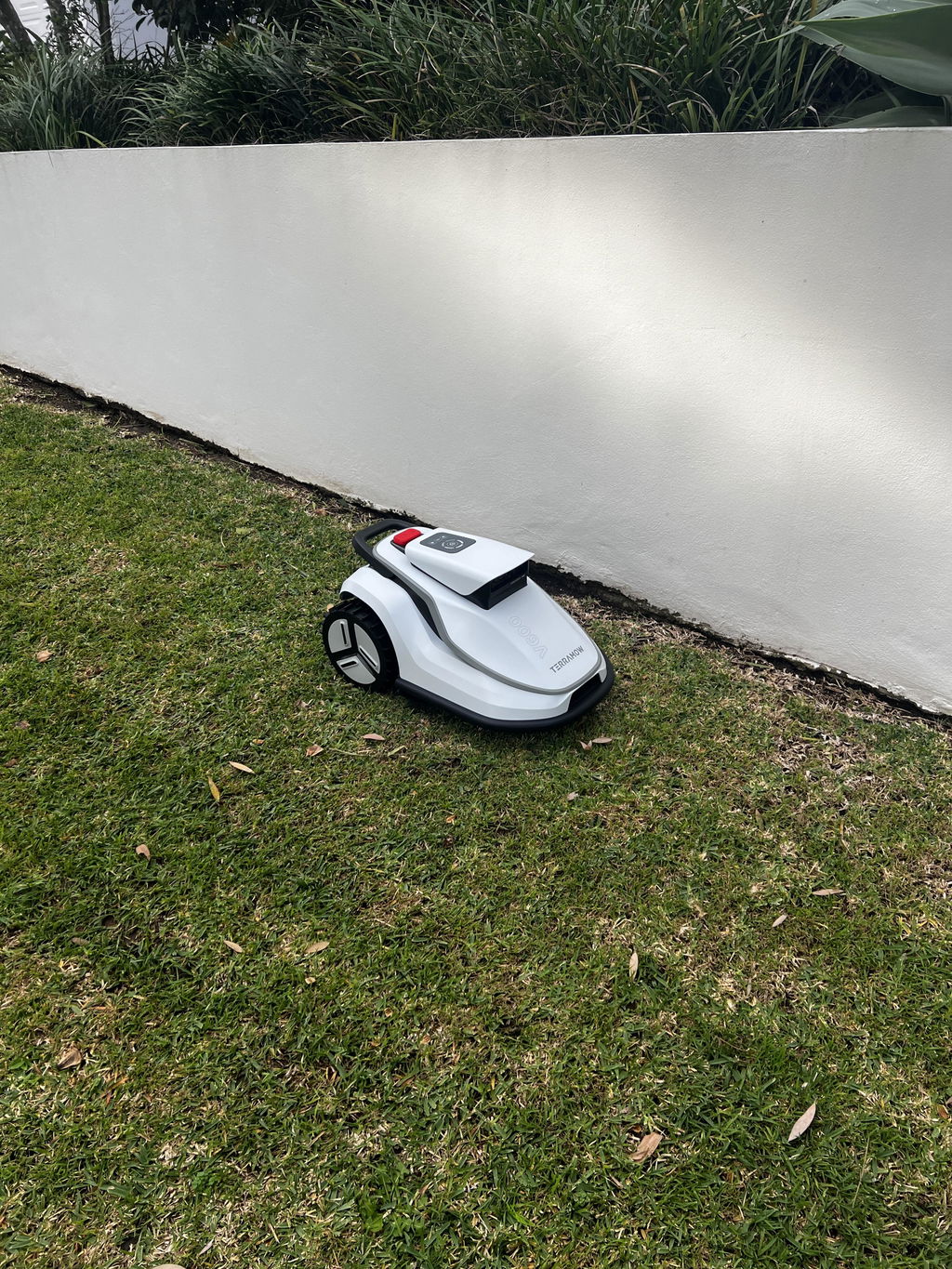
ADVINSYS is one of the better options on the market for Australian conditions. It uses a triple CMOS camera system with AI-based navigation, which handles obstacle avoidance and mapping more reliably than older wire-based systems. The mower uses what the company calls a "fish-tail" turning pattern, essentially a softer, wider arc at the end of each pass, which reduces the wear on grass at turning points by a meaningful margin. Setup takes around 5 minutes for most yards, and from there it's managed through an app that lets you set different schedules for each month of the year.

Rain, Soil, and When Not to Mow
Most decent robot mowers have rain sensors built in, and it's worth understanding why they matter rather than just treating them as a convenience feature.
Wet grass clippings don't mulch cleanly. They clump and sit on the surface, which can block light and lead to fungal issues if left too long. More importantly, running a mower on waterlogged soil compacts it. Compacted soil drains poorly, which makes the waterlogging problem worse over time. The rain sensor pause is genuinely useful, not just a gimmick.
Regional Differences Across Australia
Australia is a continent, not a single climate zone. The Bureau of Meteorology's climate data shows just how different mowing seasons can be across the country.
Queensland & Northern Territory (Tropical / Sub-Tropical)
The wet season (November–April) brings intense growth. Robotic mowers should run daily during this period. During the dry season, however, lawn growth slows dramatically or nearly stops, and mowing can be reduced to once a week or even once every two weeks. Couch and Buffalo thrive here.
New South Wales & ACT
A classic temperate climate with hot, dry summers in the west and milder coastal conditions. Most Sydney and coastal NSW lawns peak in summer. Inland areas may need to water heavily during summer to maintain growth. Follow the standard seasonal schedule above.
Victoria & Tasmania
The coolest major climates in mainland Australia. Warm-season grasses slow significantly in winter. If you have a cool-season lawn (Fescue, Ryegrass), you'll actually mow more in winter and spring than summer. Check out the Gardeners' World guide to mowing schedules for cool-season grass inspiration that applies to Tasmania and alpine Victoria.
Western Australia & South Australia
Mediterranean-type climates with dry summers and wet winters. Lawns often stress and become semi-dormant in the height of summer without irrigation. Ramp up mowing in autumn as rain returns and growth picks up. Zoysia and drought-tolerant Couch varieties are popular here for a reason.
Getting the Schedule Right Is Worth the Effort
There's no single answer to how often you should mow. The right frequency depends on what you're growing, where you live, and what time of year it is, and it shifts throughout the year in ways that a fixed weekly schedule simply can't account for.
The advantage of a robot mower is that once you've set it up correctly, it handles all of that for you. A bit of time spent thinking through the schedule at the start of each season pays off considerably over the months that follow. A lawn that's been mowed at the right frequency all season is denser, healthier, and far less work to maintain than one that's been on an arbitrary timetable.
If you're still working out which robot mower suits your yard, ADVINSYS is a reasonable place to start looking, particularly if you have a larger or more complex lawn where navigation and obstacle handling matter.